





1776 Was a Libertarian Revolution: We Must Return to Our Libertarian Republic and Nation With Libertarian Nationalism
Alright—strap in. This is a sermon, not a spreadsheet.
If you long for a free America—not the bureaucratic mirage we shuffle through today, but a nation grounded in limited government, individual rights, and the unapologetic protection of life, liberty, and property—then say it plainly: you are longing for a more Libertarian nation. And if you want that liberty to actually survive in the real world—anchored to a people, a culture, and a constitutional order—then you already belong, whether you like the label or not, to Libertarian nationalism.
There is no contradiction here. Liberty does not float in the air like a ghost. It lives somewhere—or it dies everywhere.
The Founders understood this instinctively. They did not design a universal welfare empire, a global democracy project, or a managerial state staffed by credentialed experts. They designed a nation—with borders, laws, customs, and a shared moral understanding—precisely so that government power could be chained down. The Constitution is not a love letter to authority; it is a cage built for it. Federalism, separation of powers, enumerated rights—these are not progressive aspirations. They are libertarian restraints, forged by men who feared centralized power more than they feared disorder.
They believed rights were pre-political—not granted by kings, parliaments, or agencies—but endowed by nature or God. Government existed not to engineer outcomes, but to protect what already belonged to individuals. That worldview is recognizably Libertarian, whether modern academics are comfortable admitting it or not.
But here’s the hard truth many liberty-lovers avoid: liberty requires a home.
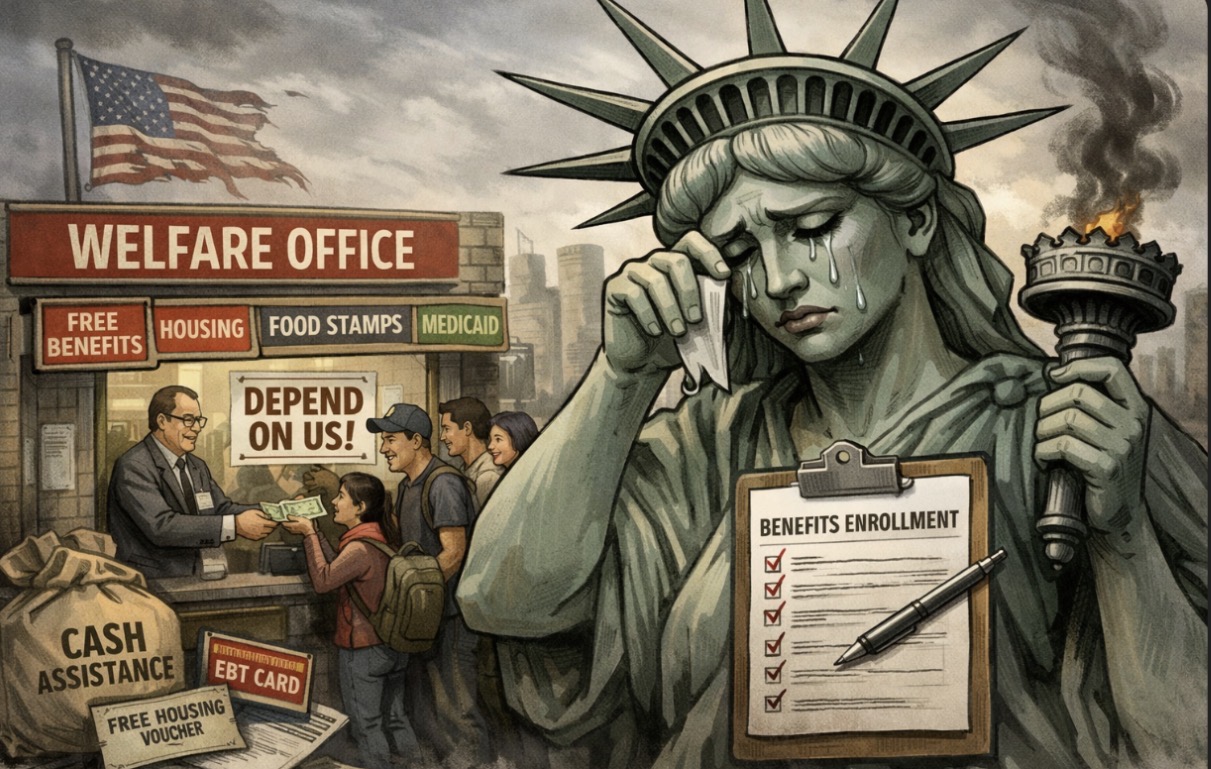
A borderless, post-national, administratively centralized state does not produce freedom. It produces dependency, surveillance, and eventually force. When a government promises everything to everyone, it must control everything—and that means controlling you. Welfare states demand higher taxes, broader enforcement, deeper surveillance, and increasingly aggressive policing to sustain themselves. That is not a bug. It is the logic of the system.
Libertarian nationalism rejects this trajectory. It says: the purpose of a nation is not to manage humanity, but to secure liberty for its own people under a limited, consent-based government. National sovereignty is not the enemy of freedom—it is the firewall that prevents freedom from being diluted, redistributed, and regulated out of existence.
This is not ethnic nationalism. It is constitutional nationalism. A belief that a specific people, under a specific legal order, can choose to limit their government—and defend that limitation against internal decay and external pressure. Without that shared commitment, liberty dissolves into abstraction, and abstraction always loses to power.
So if you find yourself yearning for the America that distrusted politicians, feared standing armies, rejected permanent bureaucracies, and believed the citizen—not the state—was sovereign, stop apologizing for it. That instinct is not backward. It is revolutionary.
You don’t want less America.
You want America as it was intended to be.
And that means a nation that is unapologetically Libertarian in principle, national in structure, and jealous of its liberty—because history teaches one lesson with brutal consistency:
Freedom that belongs to everyone
is eventually owned by no one.
1776 Was a Libertarian Revolution
Let’s go all the way back—past the slogans, past the myths, past the marble statues—and look at the Founding for what it actually was: a radically libertarian act by the standards of its time, and in many ways by the standards of ours.
The American Founding was not born out of a desire to govern others. It was born out of a refusal to be governed beyond consent. That distinction matters. The Revolution was not sparked by a king’s cruelty in the abstract, but by a creeping system of taxation, regulation, and enforcement imposed from afar—customs duties, trade controls, quartering of troops, admiralty courts, and executive decrees that bypassed local law. The colonists recognized the pattern instantly: power unmoored from consent always grows.
That insight is libertarian at its core.
The Founders did not argue that government was unnecessary. They argued that it was dangerous. Necessary, yes—but only within narrow bounds, constantly watched, constantly restrained, and always subordinate to the individual. This is why their writings obsess over limits rather than goals. They did not draft a Constitution promising outcomes. They drafted one enumerating powers—everything else was forbidden. That alone places them far closer to modern libertarianism than to any contemporary ideology that treats government as a problem-solver.
Consider the central claim of the Declaration: rights are not granted by government. If you accept that premise, the rest follows inexorably. If rights preexist the state, then the state is morally inferior to the individual. It may act only as an agent, never as a master. That is not social democracy. That is not progressivism. That is natural-rights libertarianism, articulated in 18th-century language.
Property, in particular, was treated as foundational—not optional, not conditional, and not subject to redistribution by political fashion. To the Founders, property was not merely land or wealth; it was the material expression of autonomy. To violate it without due process was to violate liberty itself. This is why taxation was so explosive a question. “No taxation without representation” was not a procedural complaint—it was a declaration that coercive extraction without consent is tyranny.
That is a libertarian moral claim, not a nationalist slogan.
Even the structure of the original federal government reflects deep skepticism of centralized authority. No income tax. No standing army in peacetime without legislative approval. No federal police force. No national education system. No welfare bureaucracy. Most power was left with states, and beyond that, with communities and individuals. The federal government was intentionally anemic—strong enough to repel invasion and enforce contracts, but too weak to dominate daily life.
Ask yourself honestly: what modern ideology is closer to that vision?
It wasn’t progressivism.
It wasn’t socialism.
It wasn’t technocracy.
It was a libertarian republic, nested inside a nation.
The Founders also understood something that modern libertarians sometimes neglect: liberty requires moral and cultural constraints that cannot be supplied by government. They assumed a population capable of self-restraint, voluntary cooperation, and local governance. When they spoke of virtue, they did not mean state-imposed morality; they meant the social capital that makes minimal government possible. Without it, liberty collapses under its own weight and invites authoritarian replacement.
This is where libertarian nationalism completes the picture.
The Founding generation did not imagine their system working everywhere, for everyone, at all times. They believed it worked for this people, in this place, under this constitution. That humility is often misread as exclusion. In reality, it was prudence. They knew that a free society depends on shared norms, legal continuity, and loyalty to a constitutional order—not abstract allegiance to humanity at large.
Universalism, when enforced politically, becomes empire. The Founders rejected empire. They rejected it under the British crown, and they warned relentlessly against becoming one themselves. Foreign entanglements, standing armies, debt—these were not side concerns. They were seen as existential threats to liberty because they concentrate power and normalize emergency rule.
Again: a libertarian diagnosis.
What has changed is not human nature, but our willingness to admit what the Founders already knew. A government empowered to manage society will eventually manage it by force. A nation unwilling to defend its constitutional limits will watch them erode in the name of compassion, safety, or efficiency. And a people that forgets that liberty must be structured, bounded, and defended will be ruled by those who remember power more clearly.
So when you say the Founders were libertarians, you are not projecting modern ideology backward. You are recognizing a lineage. Their language was different. Their context was different. But their core commitments—limited government, individual sovereignty, property rights, consent, and deep suspicion of centralized power—are unmistakable.
Libertarian nationalism does not betray the Founding.
It finishes the sentence they began.
A free people,
in a self-governing nation,
with a government chained down so tightly
that it can never forget
who it works for—and who it does not.
A Libertarian Republic, If We Can Keep It
And so we arrive at the unavoidable conclusion—the one that keeps circling back no matter how far modern politics tries to flee from it:
If America is to remain America in any meaningful sense, we must return to our founding principles, not ceremonially, not rhetorically, but structurally and unapologetically. We must recover the truth that this nation was meant to be libertarian in character, governed by a libertarian republic, because that is the only political form capable of giving liberty a durable home.
The Founders did not view liberty as a temporary condition to be balanced against administrative convenience. They treated it as the first principle—the thing from which all legitimate authority flows. Government was not the source of rights, prosperity, or moral order. It was a hired guard, nothing more. When it overstepped that role, it became indistinguishable from the threats it was created to deter.
We have forgotten this, and the consequences are everywhere.
We now live under a system where federal power expands automatically, where agencies legislate without votes, enforce without juries, and punish without accountability. Where emergencies never end, spending has no ceiling, and debt is treated as a moral abstraction rather than a chain on future liberty. Where citizens are increasingly managed as risk profiles, data points, or beneficiaries—never as sovereign individuals.
This is not an evolution of the American experiment.
It is a departure from it.
Getting back to our founding principles does not mean nostalgia or reenactment. It means reasserting the original logic of the system: liberty must be structurally protected, or it will be politically sacrificed. Rights written on paper mean nothing if power is allowed to consolidate beyond the reach of consent. A constitution that can be “reinterpreted” to authorize anything authorizes nothing in practice.
A libertarian republic is not utopian. It does not promise equality of outcome, perpetual safety, or guaranteed comfort. What it promises is something far rarer and more valuable: room to live freely, to take risks, to build, to fail, to succeed, and to associate without permission. It assumes adults capable of governing themselves and rejects the premise that a permanent ruling class is necessary to manage society.
That assumption is radical today—but it was normal in 1776.
And here is the point modern politics refuses to confront: liberty cannot exist in a vacuum. It requires a nation willing to defend it, legally, culturally, and politically. A borderless administrative state cannot preserve freedom because it has no limiting principle. A universal welfare empire cannot protect rights because it must constantly override them to function. Only a self-governing people, bound by a shared constitutional order, can restrain their own government over time.
That is why America must rediscover itself not merely as a country, but as a libertarian nation—a nation whose purpose is not to manage humanity or correct every inequity, but to secure liberty for its people and pass it on intact.
Liberty needs a home.
Not a slogan.
Not a global project.
Not a bureaucratic program.
A home with walls strong enough to hold back power.
With laws clear enough to bind rulers.
With citizens jealous enough of their freedom to refuse its quiet theft.
The Founders gave us the blueprint for such a home. We have spent generations renovating it into something unrecognizable—adding agencies, annexes, emergency exits, and control rooms until the original structure is barely visible beneath the scaffolding.
Now we face a choice.
We can continue down the path of managed decline—trading liberty for promises, sovereignty for safety, and citizenship for administration. Or we can reclaim the radical idea at the heart of the American experiment: that free people do not need to be ruled, only protected.
To choose the latter is not extremism.
It is fidelity.
Fidelity to a nation born in defiance of centralized power.
Fidelity to a republic designed to restrain itself.
Fidelity to the belief that liberty is not dangerous—
but losing it is.
If America is to endure as anything more than a geographic expression, it must once again become what it was intended to be:
A libertarian republic
within a self-governing nation
that finally remembers its highest duty—
to give liberty a home,
and never surrender the keys.