







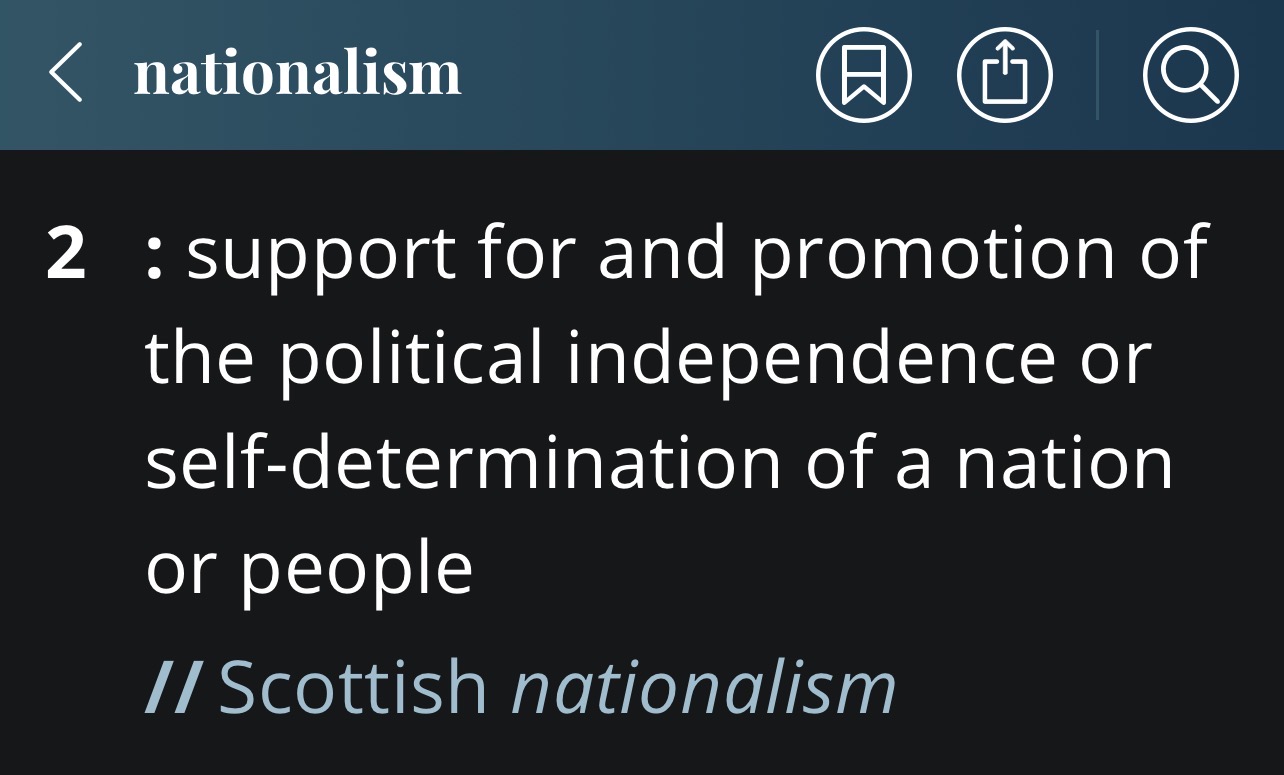

Stop The Aggressors. Start With The State: That’s NAP-First Libertarian Nationalism
First, I feel I must defend NAP-First Libertarian Nationalism from the pearl-clutchers and the sensationalism about nationalism from the utopian NAP believers and anarchists. I’m there with you on the skepticism of government, especially national governments. But please take a moment and hear me out. Nationalism can be good or bad. We must have the moral compass and judgment to even consider this kind of nationalism and we need all NAP believers to help us ensure a home for liberty. I just want to reiterate there is one truth: nations are here to stay and governments are here to stay, unfortunately. Hopefully, we can at least agree on that so that we can take the next steps together.
Anti-nationalism absolutists and NAP purists fear nationalism because they associate it only with empire and ethnic supremacy, without considering its role in limiting power, enforcing rights, and giving liberty a jurisdiction. They treat nationalism as inherently evil, without distinction or tradeoff analysis. They assume nations are obsolete and haven’t grappled with enforcement, jurisdiction, or accountability. Border-blind libertarians highlight a specific omission: they value liberty but ignore the role of boundaries in enforcing it. Abstract universalists reason at the level of humanity-in-general and skip institutions, scale, and enforcement. National-power naïfs fear nationalism without recognizing that power doesn’t disappear—it relocates. Enforcement-agnostic libertarians support principles but avoid the question of who enforces them. Stateless idealists employ utopian thinking without calling it what it is- stupid.
Libertarians love the Non-Aggression Principle(NAP) because it is clean, absolute, and morally clarifying in a world built on coercion, theft, and lies. It draws a hard line and says no—no to violence, no to theft, no to the initiation of force. But here is the truth too many libertarians refuse to say out loud: the NAP is not a government, not a legal code, and not a self-enforcing system. It is a moral constraint, a compass for judging power, not a machine that runs a civilization. Pretending otherwise has left libertarians standing unarmed while the state consolidated power, expanded borders of authority, and laughed at our purity tests.
The fantasy that liberty will spontaneously emerge if we abolish borders, dissolve nations, and reject all collective enforcement is not radical—it is naïve. Where there are no boundaries, there is no jurisdiction; where there is no jurisdiction, there is no accountability; and where there is no accountability, power does not disappear—it centralizes, hardens, and becomes unanswerable. You do not defeat power by refusing to organize against it. You defeat power by constraining it inside structures designed to break it when it grows too large. That requires a defined people, a defined territory, and institutions that answer downward to citizens instead of upward to empires.
Libertarian Nationalism is not the worship of the state; it is the chaining of it. Statism demands loyalty and obedience. Libertarian Nationalism demands limits and accountability. It says the nation exists to protect pre-existing rights, not to manufacture them; that borders exist to define responsibility, not to dominate others; that citizenship is consent, not blood or conquest; and that the state is a tool to be used cautiously, not a god to be feared or adored. A nation is a fence, not a throne, and without a fence, the strongest predator always wins.
The NAP cannot function without a bounded community willing and able to enforce it. Someone must decide what constitutes aggression, stop it when it occurs, resolve disputes, and defend against those who reject the rule entirely. These tasks require judgment, coordination, and—uncomfortable as it is—defensive force. The NAP tells us when force is illegitimate, but it does not resolve disputes about fraud, externalities, borders, invasion, or enforcement conflicts. Every functioning society adds rules beyond moral axioms; the only question is whether those rules are constrained by the NAP or used to bury it.
Unbounded enforcement does not produce freedom—it produces a global administrative state. Open borders without sovereignty do not lead to voluntary cooperation; they lead to international bureaucracies, global taxation, global policing, global speech controls, and global surveillance regimes that no one can vote out and no one can escape. Libertarian Nationalism is not exclusionary; it is defensive. It is about containment—keeping power small enough to resist, close enough to confront, and limited enough to dismantle. A thousand small governments can be challenged. A single planetary authority cannot.
The adult libertarian position is not that coercion can be abolished entirely, but that it must be minimized, localized, constrained, and constantly justified. This means borders with due process, enforcement with strict limits, law aimed at clear aggression, restitution over punishment, decentralization over empire, and exit over obedience. This is not a compromise with statism; it is a refusal to surrender reality to utopian paralysis. Liberty that cannot survive contact with human nature is not liberty—it is a slogan.
If your vision only works in a world where everyone already agrees with you, it is not a political philosophy; it is a moral performance. Liberty does not survive on elegance alone. It survives through institutions capable of resisting bad actors, foreign threats, and the eternal temptation of power. The NAP is the compass, but a compass without a vessel leaves you spinning in open water. Refuse the ship and you do not remain pure—you drown, morally correct and politically irrelevant.
The state is dangerous, but chaos is not freedom, and power without boundaries is tyranny by another name. Libertarian Nationalism is the narrow path between submission and dissolution: a nation without empire, enforcement without worship, order without servitude, and liberty that can defend itself. If libertarians want the NAP to matter outside of essays and arguments, they must be willing to build something strong enough to protect it without becoming the monster they oppose. That fight is not theoretical anymore. It is here, and refusing to engage it is the fastest way to lose.
NAP lovers, let us consider NAP-First Libertarian Nationalism.
FOR LIBERTY!