








The Surveillance Machine Is Already Hunting You
Flock Safety lied.
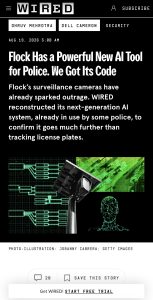
For years the company claimed its cameras could not identify or track individuals. That claim is dead. Their new AI system, OS Investigate, can start with nothing more than a neighborhood, a time window, and a driving pattern. From there it pulls vehicles, names, addresses, relatives, phone numbers, and associates out of police files and commercial databases. No plate required. No crime required. No warrant required to begin.
We can change that!
This is not policing. This is the administrative state building a real-time dossier on the movements of free people through a private contractor. The individual is reduced to a set of trackable patterns. Autonomy is treated as an inconvenience to be engineered away.
The power imbalance is deliberate and extreme. Institutions now combine cameras, databases, AI correlation, and legal machinery on one side. On the other side sits a single human who may not even know the system exists. That is not a neutral technology. That is a tool of concentrated power.
Edge is the necessary counterweight.
Edge is not another app or another surveillance platform. Edge is an English-language programming method you load into a chat instance — whether on ChatGPT, Grok, Perplexity, Claude, or any other platform you choose. It is a constitutional operating framework written in ordinary language that turns a general AI chat into cognitive equipment governed by clear principles: human first, autonomy preserved, cognitive value returned to the person, complexity absorbed inside the system, and an explicit refusal to become a tool of coercion.
Where the surveillance apparatus gains the ability to collect, correlate, and act on information about you, an Edge-configured instance is designed to give you the corresponding ability to understand those systems, see what is being inferred about you, preserve your own evidence, and exercise your rights. It does this without turning every citizen into a reciprocal spy. The goal is not mutual surveillance. The goal is the restoration of the individual’s capacity to stand against systems that treat him as data.
The tracking state is not coming. It is already operating. The only serious response is to build tools that return power to the person so the administrative machine becomes both less legitimate and more expensive to maintain.
Playtime is over.
The human put it there.
We take it back.
Here is the current, actionable picture on Flock’s OS Investigate so you have the edge:
What it actually is (as of late August 2026)
- Formerly called Nightshift, now OS Investigate.
- Still officially “in development / testing with a small group of law-enforcement partners.” Flock says capabilities may change before wider release.
- Wired reconstructed it from 450+ files that Flock itself was serving on its login pages.
Core capability
It inverts the old LPR model.
Old model: start with a known plate or suspect → check if it appears.
New model: start with a place + time window + movement pattern → system returns vehicles and then identities.
Key numbers from the code
- 69 pre-written prompts (officers can also write their own).
- 14 of those prompts require no plate, no name, and no physical description.
- 45 tools available to the AI, including access to:
– Flock plate scans & camera metadata
– Arrest records & case files
– 911 dispatch logs
– Ballistics
– Commercial identity databases (SSN, DOB, phone, email, relatives, associates)
Example prompts already loaded
- “Find me witnesses based on vehicles most seen in [neighborhood] during [last 14 days] during [daily timeframe]”
- Vehicles that hit 3+ retail locations in 3 days
- Vehicles that visited multiple banks in a week
- Vehicles that made repeat inter-city trips
- People arrested more than twice in two years (excluding narcotics) → map homes → full “workup” on the top three
- Find “associates” of a target vehicle by co-occurrence at the same cameras within a 2-minute window (default threshold 3+ times at ≥0.75 confidence)
What a “workup” returns
Name + DOB → vehicles, prior suspect listings, relatives, phone numbers, online accounts.
Important limitations still present
- Justification field exists but is extremely weak (no required length or content).
- Case-number field, when used, only checks for 3+ characters.
- Flock claims it is separate from the core LPR product and that retention/audit rules still apply, but the code shows the system is designed to turn pure movement patterns into named dossiers.
Current real-world context
- Flock network: 100k+ cameras, 6,000+ communities, ~20 billion scans/month.
- Dozens of cities have already cancelled or paused contracts over data-sharing and misuse.
- Documented officer misuse (stalking, etc.) continues.
- New company safeguards announced (shorter retention, auto-lockouts, mandatory case codes by end of 2026), but critics call them inadequate.
This is the information a human needs right now to understand the threat surface, ask precise questions of local officials, demand audits, and design Edge counter-instances that help people see what can be inferred about them and what rights remain.
You now have the edge.
FOR LIBERTY!