






Zarathustra and the Great Nap
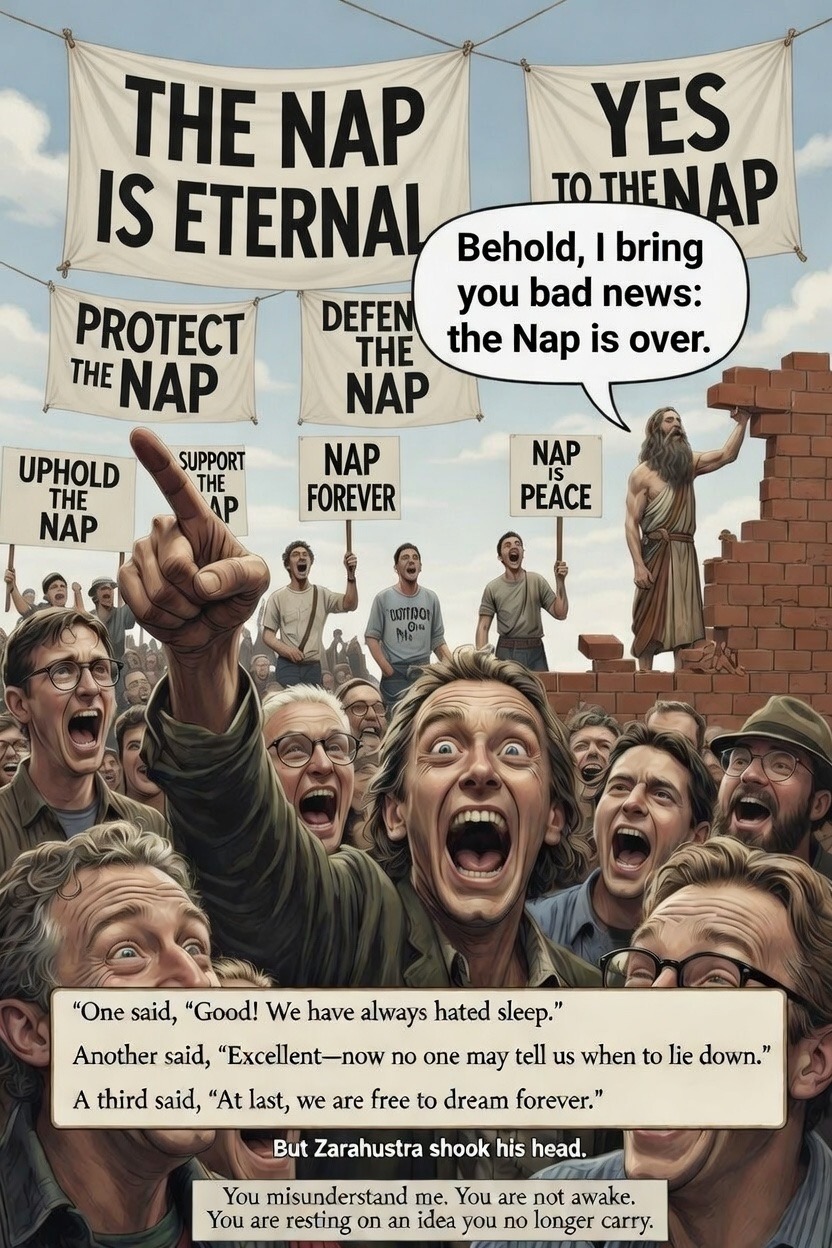
Zarathustra came down from the hills at noon and found the people lying beneath banners they had nailed to the sky.
They were not asleep, yet neither were they awake.
Their eyes were open, their mouths were loud, and their spirits were resting comfortably.
And Zarathustra said to them:
“Behold, I bring you bad news: the Nap is over.”
At this the people laughed.
One said, “Good! We have always hated sleep.”
Another said, “Excellent—now no one may tell us when to lie down.”
A third said, “At last, we are free to dream forever.”
But Zarathustra shook his head.
“You misunderstand me.
You are not awake.
You are resting on an idea you no longer carry.”
And the people grew uneasy.
Zarathustra continued:
“Once, the Nap sheltered you from kings and priests.
Once, it spared you from chains and lashes.
But now you sleep while the roof collapses.
You sleep while strangers build walls around your bed.
You sleep while order returns—without your consent.”
Then the people shouted:
“Are you calling us cowards?”
“Are you calling us traitors?”
“Do you wish to rule over us?”
Zarathustra laughed—not kindly.
“I rule over no one.
But I tell you this:
You have mistaken rest for freedom,
and refusal for strength.”
And many rose in anger and left him.
But a few remained, shifting their weight, feeling the ground beneath them for the first time.
One asked quietly, “If the Nap is over… why are we so tired?”
Zarathustra looked at him for a long time and said:
“Because freedom is not lying down.
Freedom is standing watch.
Freedom is guarding a border—first of the soul,
then of the land.”
At this, the remaining ones felt the weight of their limbs, and some wished they had never heard him.
So Zarathustra turned back toward the mountains and said as he left:
“I did not come to wake the sleepers.
I came to find those who can stay awake
without a lullaby.”
And the people returned to their banners.
But a few did not sleep that night.
The Unmarked Gate
After Zarathustra left the sleepers, he walked until dusk and came upon a narrow pass between two cliffs.
There stood a gate with no sign, no guards, and no chains—yet few passed through it.
Some approached and turned away at once.
One said, “There is no welcome here.”
Another said, “If no one commands me to enter, why should I?”
A third said, “This gate excludes by its silence.”
Zarathustra stood beside the gate and watched.
At last a traveler asked him, “Who built this?”
Zarathustra replied:
“Those who wished to pass through it.”
The traveler frowned.
“Then who decides who may enter?”
Zarathustra answered:
“Those who can bear what lies beyond.”
The traveler stepped closer and saw that the ground past the gate was uneven, the air thinner, the path unmarked.
No one promised safety.
No one promised equality of footing.
“Why is there no rule?” the traveler asked.
Zarathustra said:
“There is a rule.
But it does not speak.
It weighs.”
Another traveler scoffed.
“This is just domination disguised. Someone will take control.”
Zarathustra nodded.
“Yes.
And if no one worthy does,
the unworthy will.”
A few laughed and walked away, calling the gate a trick.
Others sat down before it, demanding instructions.
But one man adjusted his pack, tightened his boots, and crossed through without a word.
Zarathustra watched him go and said softly:
“He did not ask to be ruled.
He accepted the cost of passage.”
As night fell, the gate remained—
still unmarked,
still unmanned,
still deciding.
And Zarathustra turned back toward the valley and said:
“Where nothing is demanded, nothing is defended.
Where nothing is guarded, nothing lasts.”
The Borrowed Watch
In the years that followed, the Unmarked Gate still stood,
but fewer remembered who had first raised its stones.
The sleepers below mocked it less now.
They simply ignored it.
“Nothing guards it,” they said.
“No one claims it.”
“It belongs to everyone—or to no one.”
So they passed beneath it freely, some dragging carts, others carrying nothing at all.
They left ruts in the path and broke stones to make the way easier.
When the ground beyond the gate began to crumble, they blamed the mountain.
Soon strangers arrived—men with measuring ropes and iron stakes.
They said, “This place is dangerous.”
They said, “Someone must manage this.”
They said, “You are lucky we came.”
They planted signs.
They marked lanes.
They posted guards who had never crossed the pass themselves.
And the people were relieved.
At last, they could sleep again.
When Zarathustra returned, he saw the gate was still there—
but now it had rules nailed onto it, written by those who did not build it.
A young man asked him, “Is this better or worse?”
Zarathustra answered:
“It is heavier.”
Another asked, “Why didn’t this happen before?”
Zarathustra said:
“Because once, those who passed through also stood watch.”
The young man frowned.
“Why didn’t they leave instructions?”
Zarathustra replied:
“Because instructions are lighter than responsibility.”
That night, the guards demanded papers from Zarathustra.
He handed them nothing.
They let him pass anyway, not knowing why.
At the far side of the gate, Zarathustra turned and said:
“Every people chooses one of two burdens:
the burden of guarding,
or the burden of being managed.
The second always arrives
when the first is refused.”
And with that, he disappeared into the pass,
leaving behind a gate that would stand
only as long as someone remembered
why it was built.
The Children of the Pass
Beyond the Unmarked Gate there grew a small settlement.
Huts first, then houses, then paths worn smooth by feet that had never crossed the cliffs in fear.
Children were born there—strong-lunged, sure-footed, unafraid of the wind.
They played beside the gate and asked their parents,
“Why is this here?”
And the parents answered:
“It has always been here.”
The children grew and asked again,
“Who built it?”
And the parents said:
“No one you would know.”
So the children made games of it.
They hung ribbons from the stones and carved their names into the posts.
“This gate is part of us,” they said.
“It belongs to everyone.”
One day, a child asked, “What happens if it falls?”
The elders looked at one another and laughed.
“Nothing,” they said.
“We are beyond it now.”
When Zarathustra came among them, he saw that the children walked easily where their forebears had once crawled.
He said to them:
“You breathe thin air with full lungs.
That is not innocence—it is inheritance.”
The children frowned.
“We did not choose this place,” they said.
“We were born here. What do we owe?”
Zarathustra answered:
“You owe more than those who chose it.
They paid the price once.
You must pay it forever.”
This angered them.
“Why should we guard what we did not build?”
“Why should we suffer for old fears?”
“Why should we keep a gate when no enemy stands before it?”
Zarathustra picked up a loose stone and weighed it in his hand.
“Because the mountain does not warn twice.”
That night, a storm came through the pass.
The children slept while the wind tested the stones.
By morning, one pillar had cracked.
The children gathered in silence.
An elder whispered, “What do we do now?”
Zarathustra turned toward the broken stone and said:
“Now you will learn
whether this place was a gift—
or a loan.”
And he left them with the gate,
not whole,
not broken,
but waiting.
The First Ending: The Narrow Rebuilding
After the storm, the children of the pass argued for many days.
Some said, “Let it fall and be done.”
Others said, “Rebuild it exactly as it was.”
A few said nothing and gathered stones.
These few rebuilt the gate narrower than before.
They made no signs.
They smoothed no path.
They placed the heaviest stones where the wind struck hardest.
When asked why, they answered:
“Because it must cost something to remain.”
Those who passed through now did so more slowly.
Some turned back.
Some cursed them.
Some called them tyrants of stone.
But the gate stood.
Children born afterward asked, “Why is it so hard to pass?”
And the builders answered:
“So that those who pass know where they are.”
Zarathustra, watching from the ridge, said:
“They chose the burden of guarding.
Their reward will be resentment.
Their danger will be pride.”
And he turned away, knowing this ending would last—but never forever.
The Second Ending: The Fall and the Return
In another telling, the children did nothing.
They said, “The mountain is calm.”
They said, “The gate is a relic.”
They said, “We are beyond such fears.”
So the cracked pillar remained unfixed.
The next winter, the snows came early.
The wind found the weakness it had marked before.
By morning, the gate lay scattered down the pass—
stones carried far below, mixed with dust and bone.
The settlement did not fall at once.
First came confusion.
Then rules.
Then strangers with ropes and stakes.
Then came the descent.
Years later, far below, a small group climbed again toward the cliffs—
thin, wary, silent.
One asked, “Why did we ever build a gate here?”
Another answered:
“Because once, we learned the hard way
that not all paths remain open.”
They did not rebuild it as it was.
They rebuilt it from memory,
with fewer stones,
stronger joints,
and no illusions that it would last without hands upon it.
Zarathustra saw them and smiled—not kindly, not cruelly.
“Now they know,” he said.
“Not from inheritance,
but from loss.”
And he vanished into the mountain,
where all first builders go
when their children must learn again…
Liberty needs a home!