




The Dangerous Administrative Leviathan
How the Democratic Party Built a Permanent Ruling Architecture — and Why Liberty Is Now Under Siege
I write this not as a partisan loyalist, but as a libertarian who believes the proper size of government is small, restrained, and constantly mistrusted. And today, that government no longer feels like a referee. It feels like an occupying force—bureaucratic, permanent, and unaccountable.
If Americans are wondering why their freedoms feel more conditional every year, the answer is not subtle. It is structural. And at the center of that structure sits the Democratic Party.
Government for Government’s Sake
The Democratic Party no longer merely uses government—it worships it.
Every major institutional pillar of the modern state now leans in one direction:
- Civil service bureaucracies
- Public-sector unions
- Education systems
- Regulatory agencies
- Healthcare administrations
- Grant-funded NGOs
These are not neutral bodies. They are political ecosystems, and they overwhelmingly align with one party because that party promises what they crave most: more power, more funding, more permanence.
This is not an accident. It is a feedback loop.
Bigger government creates more administrators.
More administrators demand more regulation.
More regulation justifies more administrators.
And the political party that feeds this loop becomes the default ruling class.
This is how freedom dies—not in a coup, but in committees, guidance memos, and “best practices.”
The Myth of Neutral Institutions
We are told endlessly that agencies are “non-partisan.” That is technically true and practically meaningless.
Institutions don’t vote—but the people who staff, unionize, and advocate for them do. And when nearly every organized government-adjacent group pushes in the same political direction, neutrality becomes a fairy tale told to taxpayers to keep them quiet.
The Democratic Party has perfected a strategy that doesn’t require winning hearts forever—only controlling institutions permanently. Elections become theater when the bureaucracy remains unchanged regardless of who wins.
This is not liberalism.
This is soft authoritarianism dressed up as compassion.
The Institutional Reality: Who Actually Supports the Democratic Party
To understand why this machine is so powerful, you have to look at who supports it—not rhetorically, but structurally. When you include federal, state, and local levels, and count all supporting organizations (unions, NGOs, professional associations, contractors, and advocacy groups), a clear pattern emerges.
1) Public-Sector Unions (Federal, State, Local)
These are the largest organized political force connected to government.
- Civil service unions
- Teachers’ unions
- Healthcare worker unions
- State and municipal employee unions
They overwhelmingly support Democrats because Democrats:
- protect collective bargaining,
- expand staffing and budgets,
- resist privatization,
- defend the permanence of agencies themselves.
This bloc alone provides money, manpower, endorsements, and narrative cover—cycle after cycle.
2) Education Institutions
K–12 systems, universities, and education bureaucracies form an ideological conveyor belt.
- Teachers’ unions and administrators
- Faculty associations
- Education NGOs
- Accreditation bodies
This ecosystem is deeply aligned with Democratic politics, not just on funding, but on worldview. It produces voters, activists, and staffers who cycle directly into government.
3) Healthcare and Human Services Bureaucracy
Public health agencies, social-service departments, and nonprofit healthcare systems depend on:
- government reimbursement,
- regulatory favor,
- grant funding.
Their workers and advocacy arms lean heavily Democratic, while industry players hedge. The result is a net institutional tilt toward government expansion.
4) Regulatory and Administrative Agencies
Environmental, labor, financial, housing, and consumer-protection agencies exist to regulate—and regulation requires:
- more staff,
- broader mandates,
- weaker legislative oversight.
Democrats are the natural political home for these institutions because they defend administrative discretion over democratic restraint.
5) NGOs and Grant-Funded “Civil Society”
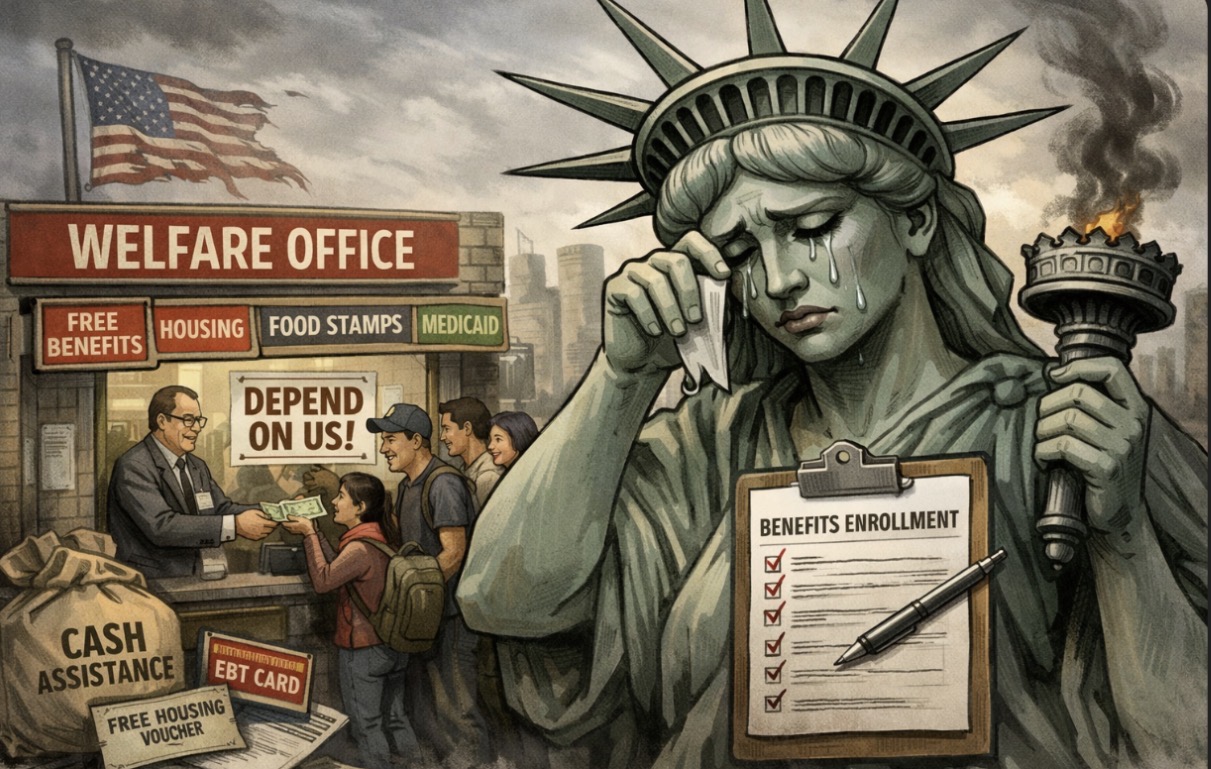
A vast shadow sector of nonprofits exists almost entirely on government funding.
- Advocacy groups
- Policy institutes
- “Community organizations”
These groups:
- lobby for more programs,
- justify agency growth,
- attack attempts at reform.
They are not independent. They are government auxiliaries, and they align accordingly.
6) Where Democrats Are Weaker (and Why It Doesn’t Matter)
Law-enforcement organizations and some defense contractors lean more Republican. But these are:
- smaller in number,
- less ideologically unified,
- often dependent on the same federal spending.
They do not offset the sheer institutional mass of the civilian administrative state.
Net result:
The Democratic Party is backed by the majority of organized government-adjacent power in America.
This is why its influence persists even when it loses elections.
Why This Is a Direct Threat to Liberty
Liberty cannot survive under a system where:
- compliance replaces consent,
- regulations outnumber laws,
- unelected officials shape daily life,
- economic survival depends on bureaucratic approval.
A government that touches everything eventually controls everything. And a party that benefits from that arrangement will never voluntarily shrink it.
The Democratic Party does not simply argue for policy differences—it advances a worldview where citizens exist to be managed, nudged, monitored, taxed, and corrected.
Freedom becomes a privilege granted by administrators instead of a right inherent to the individual.
And What About the Republicans?
Here’s the uncomfortable truth: the Republican Party has been largely inept at stopping this.
Too often, Republicans respond to bureaucratic overreach with:
- more policing,
- more surveillance,
- more enforcement powers.
In other words, they fight big government with different uniforms, not less authority.
Instead of dismantling the administrative state, they try to commandeer it. Instead of abolishing bad powers, they argue over who should wield them. This is not resistance—it is capitulation with a badge.
A party that believes freedom is preserved by expanding law enforcement while leaving the bureaucracy intact is not defending liberty. It is managing decline.
Why the Libertarian Fight Must Become Uncompromising
The Libertarian Party exists for one reason: to say what the other two refuse to say aloud—
The government is too big, too intrusive, too permanent, and too dangerous to be trusted with more power.
Libertarians are not radicals—we are constitutional literalists in an age of runaway administration. But we must recognize reality: we are not facing a party alone; we are facing an entire institutional order aligned against restraint.
The response must be clear:
- Shrink agencies, don’t “reform” them
- Eliminate powers, don’t regulate their use
- Defund bureaucracy, don’t merely oversee it
- Restore federalism and individual sovereignty
Liberty is not preserved by politeness when the system itself is immoderate.
Final Warning
WE MUST ELIMINATE THE DEMOCRATIC PARTY!!
A government that grows for its own sake will never stop growing on its own.
A party that derives power from that growth will never reverse it.
And opponents who merely reshuffle enforcement mechanisms will never defeat it.
Freedom survives only when citizens draw hard lines—and refuse to let those lines be administratively erased.
History does not ask politely.
Neither should defenders of liberty.
“The interventionists call themselves liberals, but they want to substitute government control for the market economy.”
— Ludwig von Mises, Planning for Freedom (1952)